Aspen Neuroscience to Present at the International Society for Stem Cell Research (ISSCR) 2025 Annual Meeting

Presentation of Data from Clinical Trial of Aspen’s Autologous iPSC-derived Approach for Neuronal Replacement Therapy in Parkinson’s Disease

SAN DIEGO, June 9, 2025 /PRNewswire/ — Aspen Neuroscience, Inc. announced its participation in “Illuminating the Future,” the International Society for Stem Cell Research (ISSCR) 2025 Annual Meeting, to be held in Hong Kong June 11-14.

Aspen Co-founder and Senior Vice President, Research and Development, Andrés Bratt-Leal, PhD will deliver a presentation, Safety, tolerability, and efficacy of transplanted autologous iPSC-derived dopaminergic precursors in moderate to advanced Parkinson’s Disease.

Dr. Bratt-Leal’s presentation will cover data for the first four patients of the ASPIRO Study*, a Phase 1/2a trial of the company’s iPSC-derived autologous cell therapy (ANPD001). The open label trial was designed to evaluate the safety, tolerability and efficacy of intracranial implantation of autologous induced pluripotent stem cell (iPSC)-derived dopaminergic neuronal precursor cells (DANPCs) in patients with moderate to advanced Parkinson’s disease.

The primary objective of the ongoing study is to assess safety and tolerability of the procedure. A secondary objective is to evaluate clinical efficacy as measured by change from baseline in multiple patient-reported and clinician-reported Parkinson’s disease outcome measures. Continued follow up and evaluation of a higher-dose cohort in the study are ongoing.

“Early data from the first four patients show that precision intracranial delivery of DANPCs is safe and well-tolerated,” reported Dr. Bratt-Leal. “Both patient-reported and clinician-reported outcomes show early signs of changes from baseline in multiple clinically meaningful outcome measures. Autologous iPSC-derived therapy as a regenerative medicine approach has the unique advantage of not requiring immunosuppressive medications.”

About Aspen Neuroscience 
Headquartered in San Diego, Aspen Neuroscience, Inc. is a clinical development-stage, private company focused on autologous regenerative medicine. The company’s patient-derived iPSC platform is used to create personalized therapies to address diseases with high unmet medical needs, beginning with autologous neuron replacement for PD. 

Aspen combines cell biology with the latest machine learning and genomic approaches to investigate patient-specific, restorative cell treatments. The company has developed a best-in-class platform to create and optimize pluripotent-derived cell therapies, which includes in-house bioinformatics, manufacturing and quality control. For more information and important updates, please visit https://www.aspenneuroscience.com or email media@prodcopy1.wpenginepowered.com.  

* The study was made possible by funding from the California Institute for Regenerative Medicine (CIRM), a state of California Agency that funds regenerative medicine, stem cell, and gene therapy research (Grant Number CLIN2-15547).

SOURCE Aspen Neuroscience, Inc.

Aspen Neuroscience to Present at American Society of Gene & Cell Therapy (ASGCT) Annual Meeting

Presentation Covers Aspen’s Autologous iPSC-derived Approach for Neuron Replacement Therapy in Trial for Parkinson’s Disease

SAN DIEGO, May 14, 2025 /PRNewswire/ — Aspen Neuroscience Chief Scientific Officer Xiaokui Zhang, Ph.D., will present at the American Society of Gene & Cell Therapy (ASGCT) 28th Annual Meeting, held this week May 13-17, at the Ernest N. Morial Convention Center in New Orleans, Louisiana. The annual meeting, the largest gathering of cell and gene therapy professionals, hosts a global audience of attendees from academia, the biotechnology and pharmaceutical industries, government, and non-profit patient foundations.

“We are excited to be part of this meeting, which covers the latest advancements in cell and gene therapies,” commented Dr. Zhang. “The members of the ASGCT community share our vision to translate the potential of these therapies into safe and effective medicines to improve patients’ lives.”

Dr. Zhang will present during the Scientific Symposium “Next Generation Strategies for Evading Immunity in Stem Cell Therapies” (Organized by the Stem Cell Committee), scheduled for Friday May 16 from 1:30 – 3:15 PM. She will discuss recent developments in personalized, autologous cell therapy research and development, including for ANPD001, Aspen’s iPSC-derived neuron replacement therapy currently under investigation for Parkinson’s disease in a Phase 1/2a clinical trial.

About Aspen Neuroscience 
Headquartered in San Diego, Aspen Neuroscience, Inc. is a clinical development-stage, private company focused on autologous regenerative medicine. The company’s patient-derived iPSC platform is used to create personalized therapies to address diseases with high unmet medical needs, beginning with autologous neuron replacement for PD. 

Aspen combines cell biology with the latest machine learning and genomic approaches to investigate patient-specific, restorative cell treatments. The company has developed a best-in-class platform to create and optimize pluripotent-derived cell therapies, which includes in-house bioinformatics, manufacturing and quality control. For more information and important updates, please visit https://www.aspenneuroscience.com.
Aspen Neuroscience Announces 6-Month ASPIRO Phase 1/2a Clinical Trial Results of Personalized Cell Therapy for Parkinson’s Disease

  • ANPD001 was well tolerated with no major safety issues in low-dose cohort
  • Patients showed early improvements in patient-reported and clinician-reported outcomes
  • Detailed Phase 1/2a trial data will be presented this week at IAPRD 2025

SAN DIEGO and NEW YORK, May 7, 2025 /PRNewswire/ — Aspen Neuroscience has released 6-month data from the first three patients dosed in the ASPIRO Phase 1/2a trial of ANPD001, an investigational autologous dopaminergic neuronal precursor cell (DANPC) therapy being studied in patients with moderate to advanced Parkinson’s Disease (PD).

After recent publication in Parkinsonism and Related Disorders, detailed 6-month data on the first three patients will be presented this week at the 30th World Congress on Parkinson’s Disease and Related Disorders (IAPRD 2025), taking place in New York from May 7-10.  Aspen Neuroscience Medical Director Avram Fraint, M.D., M.S. will present “Safety, tolerability, and efficacy of intracranial delivery of autologous iPSC-derived dopaminergic precursors in moderate to advanced Parkinson’s disease” on Saturday, May 10 during the IAPRD Guided Poster session.

“Parkinson’s disease is the second most common neurodegenerative disorder. By the time of diagnosis, most people with Parkinson’s have lost the majority of their dopaminergic neurons, leading to progressive loss of motor and non-motor function,” said Dr. Fraint. “To date, data from the first three patients in the ASPIRO study show that precision delivery of personalized DANPCs is safe and well-tolerated.”

“In this first-of-its-kind study, we are seeing clinician-reported and patient-reported improvements as well as a strong safety and tolerability profile at six months. Importantly, ANPD001 has the unique advantage of not requiring immunosuppression,” said Edward Wirth III, MD, PhD, Chief Medical Officer of Aspen Neuroscience.

“We are very encouraged by the ASPIRO study results to date. With more than one million people currently living with Parkinson’s disease in the U.S. alone, these data are promising for the Parkinson’s community, and for the autologous cell therapy field,” said Damien McDevitt, PhD, president and CEO of Aspen Neuroscience.

About the ASPIRO Study
The Autologous-derived Study of a Parkinson’s Investigational Regenerative therapy in an Open-label trial (ASPIRO) was launched in 2024 to assess safety and tolerability of ANPD001, an autologous, dopaminergic neuron cell replacement therapy for participants with moderate to advanced PD. It is the first multi-patient, multi-center clinical trial of an autologous cell therapy for PD.

The ASPIRO trial enrolls levodopa-responsive patients 50–70 years of age whose Parkinson’s disease duration, motor fluctuations, and “off” time have made oral therapies alone incompletely effective. The trial excluded patients with cognitive impairment and other comorbidities that make them high-risk for an intra-cranial therapy. All enrolled patients are under the care of a movement disorder specialist.

Primary study objectives include assessing safety and tolerability of two sequential escalating doses of ANPD001 as well as the drug delivery procedure. Secondary objectives include the evaluation of clinical efficacy, as measured by change from baseline in patient- and clinician-reported Parkinson’s disease-specific outcome measures. This includes improvements in motor symptoms and quality of life based on standard Parkinson’s disease rating scales, and improvement in “good on” time, when patients experience periods of good symptom control without medication side effects.

Primary safety and efficacy endpoints will be reported at 12 months, and continued follow up and evaluation will continue for five years. Long-term safety follow-up will continue to Year 15.

Study Procedure and Results
Administration of the DANPCs into the posterior putamen was performed with participants under general anesthesia. Precision dosing of the intended target was enabled using gadoteridol-enhanced intraoperative MRI. These three patients received five million DANPCs per putamen in a single surgical procedure using a custom syringe and cannula.

No hemorrhages nor serious intra-operative or post-operative complications were observed. No graft-induced dyskinesia have been observed. The most common adverse events in the first three patients were incision pain and tongue swelling, the latter of which is related to the prone position during surgery.

At six months there was an average improvement of 45% in the physician-reported MDS-Unified Parkinsons Disease Part III “off” score compared to baseline, and an average improvement of 71% in patient-reported MDS-UPDRS Part II scores. There was an average reduction of 2.0 hours in adjusted “off time,” and a 1.5-hour average increase in adjusted “good on” time.

About ANPD001
ANPD001 is the most advanced autologous investigational cell therapy in the United States for treating Parkinson’s disease. More information about the Phase 1/2a trial is available at clinicaltrials.gov (NCT06344026).

Aspen’s personalized approach means that patients do not require immunosuppressive (IS) drugs to dampen the body’s immune response against foreign cells. This approach will eliminate IS-associated adverse events, IS drug-monitoring requirements, and enable dosing for those with contraindications to IS therapies.

Aspen’s manufacturing process starts from a small biopsy of the patient’s own skin cells, followed by reprogramming to induced pluripotent stem cells (iPSCs) and then differentiation of the iPSCs into DANPCs. These DANPCs are transplanted into the posterior putamen, replacing cells that were lost or damaged due to disease. The quality of each person’s cells is assessed at every manufacturing stage using Aspen’s proprietary machine learning-based genomics tests.

ANPD001 has received Fast Track designation by the U.S. Food & Drug Administration (FDA).

About Aspen Neuroscience 
Headquartered in San Diego, Aspen Neuroscience, Inc. is a clinical development-stage, private company focused on autologous regenerative medicine. The company’s patient-derived iPSC platform is used to create personalized therapies to address diseases with high unmet medical needs, beginning with autologous neuron replacement for PD. 

Aspen combines cell biology with the latest machine learning and genomic approaches to investigate patient-specific, restorative cell treatments. The company has developed a best-in-class platform to create and optimize pluripotent-derived cell therapies, which includes in-house bioinformatics, manufacturing and quality control. For more information and important updates, please visit https://www.aspenneuroscience.com.

Aspen Neuroscience to Present at the International Society for Gene & Cell Therapy (ISCT) Annual Meeting

Presentations Cover Automated Manufacturing of Aspen’s Autologous iPSC-derived Neuron Replacement Therapy for Parkinson’s Disease

SAN DIEGO and NEW ORLEANS, May 7, 2025 /PRNewswire/ — Aspen Neuroscience scientists, led by Chief Scientific Officer Xiaokui Zhang, Ph.D., will present at the International Society for Gene & Cell Therapy (ISCT) Annual Meeting, held this week May 7-10 at the Ernest N. Morial Convention Center in New Orleans, Louisiana. The meeting Is the largest global cell and gene translation conference of the year, with attendees from academia, the biotechnology and pharmaceutical industries.

The presentations at ISCT focus on Aspen’s development of automated production of iPSC-derived cell therapies, including ANPD001, the company’s investigational cell therapy program for treatment of Parkinson’s disease. Ongoing production development includes a capacity expansion for autologous manufacturing at the company’s San Diego-based GMP facility as well as incorporation of machine learning to optimize cell quality.

At the Scientific Signature Series Event “Advancing Consensus on Safety and Quality Characterization During iPSC Product Development,” Dr. Zhang will act as co-Chair for Session III: Building Frameworks Using iPSC Products, and as a presenter in “Characterization of Autologous iPSC-Derived Neuron Replacement for Parkinson’s Disease.”

Dr. Zhang will also serve as Moderator of the ISCT Roundtable “Preparing for AI: Automating manufacturing of iPSC-based therapies.”

Will Ansari, Ph.D., Aspen Associate Director, Technology Development, will present “Development of a Protocol and Machine Learning Algorithms for the Derivation of Autologous Human iPSC on an Automated Platform to Enable Clinical Semi-autonomous Manufacturing.” His abstract was selected to receive the US Host Region (US West) Abstract Award.

In addition, Aspen scientist Jeanne Drucks will present a poster titled “Functional characterization of GBA1 mutations in iPSC-derived midbrain dopaminergic neurons.”

“We are excited to present our progress in automating the manufacture of iPSC-derived therapies at the ISCT meeting,” commented Dr. Zhang. “Our vision to translate the potential of autologous therapies into safe and effective medicines to improve patients’ lives by restoring lost function without the need for immunosuppressive drugs.”

Aspen Neuroscience will also serve as a sponsor of the 2025 iPSC Scientific Signature Series.

The following are specific details regarding Aspen Neuroscience’s presentations at the conference:

Presenter:Xiaokui Zhang, Ph.D. Aspen Neuroscience Chief Scientific Officer 
Event:       Moderator, ISCT Roundtable “Preparing for AI: Automating manufacturing of iPSC-based therapies”
Date:       Wednesday, May 7
Time:       10:45 to 11:45, Central Time
Presenter:Xiaokui Zhang, Ph.D. Aspen Neuroscience Chief Scientific Officer 
Event:       Chair, Session III: Building Frameworks Using iPSC ProductsSpeaker, “Autologous iPSC-Derived Neuron Replacement for Parkinson’s Disease.”
Date:       Saturday, May 10
Time:       12:30 to 3:30, Central Time
Presenter:Will Ansari, Ph.D. Aspen Associate Director, Technology Development
Event:       Poster, “Development of a Protocol and Machine Learning Algorithms for the Derivation of Autologous Human iPSC on an Automated Platform to Enable Clinical Semi-Autonomous Manufacturing.” 
Date:       Poster: Wednesday, May 7 to Thursday, May 8
Oral Presentation: Friday May 9
Time:       Poster Networking Sessions
iPSC Presentation Session: 4:15pm CT
Presenter:Jeanne Drucks Aspen scientist
Event:       Poster, “Functional Characterization of GBA1 Mutations in iPSC-derived Midbrain Dopaminergic Neurons.”
Date:       Wednesday, May 7 to Thursday, May 8
Time:       Poster Networking Sessions

About Aspen Neuroscience 
Headquartered in San Diego, Aspen Neuroscience, Inc. is a clinical development-stage, private company focused on autologous regenerative medicine. The company’s patient-derived iPSC platform is used to create personalized therapies to address diseases with high unmet medical needs, beginning with autologous neuron replacement for PD. 

Aspen combines cell biology with the latest machine learning and genomic approaches to investigate patient-specific, restorative cell treatments. The company has developed a best-in-class platform to create and optimize pluripotent-derived cell therapies, which includes in-house bioinformatics, manufacturing and quality control. For more information and important updates, please visit https://www.aspenneuroscience.com.

SOURCE Aspen Neuroscience, Inc.

Dalen Meeter Joins Aspen Neuroscience as Chief Financial Officer

CFO Further Positions Company for Growth and Continued Advancement of Clinical Programs

SAN DIEGO, April 30, 2025 /PRNewswire/ — Aspen Neuroscience, Inc., a private biotechnology company developing personalized, autologous cell therapies, has appointed Dalen Meeter, CPA, MBA, as Chief Financial Officer (CFO).

“We are excited to welcome Dalen to our executive team during this significant period of growth and development at Aspen,” said Damien McDevitt, PhD, president and CEO of Aspen Neuroscience. “His financial leadership experience within the biotech sector will be important during our corporate evolution, as we advance our clinical programs and prepare for the future.”

“It is an honor to join this groundbreaking company at such a pivotal time,” said Mr. Meeter. “I look forward to contributing to the company’s mission of developing transformative therapies for patients with Parkinson’s disease.”

With more than two decades of finance and accounting expertise, Dalen brings extensive experience in scaling private and public companies to his new role. Prior to Aspen, most recently he served as CFO of Singular Genomics Systems, Inc. After guiding Singular’s finance transformation from a private, development-stage startup to a publicly traded, commercial-stage company, he then led as CFO of the public entity.   

Before joining Singular, Dalen spent many years in Finance leadership at Illumina, as well as in auditing during his time at KPMG. Mr. Meeter holds an undergraduate degree from the University of California, Santa Barbara, and an MBA from the University of Southern California’s Marshall School of Business.

About Aspen Neuroscience
Headquartered in San Diego, Aspen Neuroscience, Inc. is a clinical development-stage, private company focused on autologous regenerative medicine. The company’s patient-derived iPSC platform is used to create personalized therapies to address diseases with high unmet medical needs, beginning with autologous neuron replacement for Parkinson’s Disease. 

Aspen combines cell biology with the latest machine learning and genomic approaches to investigate patient-specific, restorative cell treatments. The company has developed a best-in-class platform to create and optimize pluripotent-derived cell therapies, which includes in-house bioinformatics, manufacturing, and quality control. For more information and important updates, please visit https://www.aspenneuroscience.com.

The Aspen Neuroscience Team is Proud to Sponsor and Participate in the Annual Step-by-Step 5k Hosted by The Parkinson’s Association of San Diego (PASD) on Saturday, April 5th

April 1st marks the beginning of Parkinson’s Awareness Month. This Saturday, April 5th, the Aspen Neuroscience team is proud to sponsor and participate in the annual Step-by-Step 5k hosted by The Parkinson’s Association of San Diego (PASD).

This is Aspen Neuroscience’s fifth year supporting this incredible event.

Please help us make an impact by donating to sponsor individual team members and the Aspen team as a whole here: https://raceroster.com/events/2025/97165/fighting-parkinsons-step-by-step-5k/pledge/team?id=27.

All donations we raise will go directly to the Parkinson’s Association of San Diego. These funds will facilitate PASD in fulfilling their mission to enable San Diego County residents affected by Parkinson’s Disease to live their best lives through support, resources and education.

If you are curious about PASD’s resources, you can check out their website here: https://parkinsonsassociation.org/.

Aspen Neuroscience Announces Completion of First and Second Cohorts in ASPIRO Phase 1/2a Trial for Parkinson’s Disease

SAN DIEGO, Jan. 13, 2025 /PRNewswire/ — Aspen Neuroscience, Inc. has successfully completed dose escalation and the first two cohorts of patients in the ASPIRO study, an ANPD001 Phase 1/2a clinical trial in Parkinson’s Disease (PD).

The Autologous-derived Study of a Parkinson’s Investigational Regenerative therapy in an Open-label trial (ASPIRO) was launched in 2024 to assess ANPD001 in patients with moderate to severe PD.

The study is examining escalating doses, with the primary endpoint being safety and tolerability of ANPD001. Secondary endpoints include improvement in “on” time, when patients experience periods of symptom control, and improvements in motor symptoms and quality of life based on standard PD rating scales.

“This is a major milestone for the first multi-patient, multi-center clinical trial of an autologous therapy for Parkinson’s disease,” said Edward Wirth III, MD, PhD, Chief Medical Officer of Aspen Neuroscience. “We are happy to announce that to date, ANPD001 and its delivery have been well tolerated, and no serious adverse events have been observed in the first two cohorts of patients in the ASPIRO study. All patients were discharged within 48 hours, per protocol. We are now advancing the program to investigate our new commercial formulation.”

ANPD001 is the most advanced autologous investigational new cell therapy in the United States for treating Parkinson’s disease. More information about the Phase 1/2a trial is available at clintrials.gov (NCT06344026).

The study trial includes patients 50–70 years of age, and excludes patients with cognitive impairment and other comorbidities that could preclude treatment. All enrolled patients are under the care of a movement disorder specialist.

About ANPD001
ANPD001 is an investigational autologous dopaminergic neuronal precursor cell (DANPC) therapy being studied as a regenerative treatment for PD. Aspen’s personalized approach means that patients do not require immunosuppressive drugs to counteract the body’s immune response against foreign cells.

Aspen’s manufacturing process starts from a small sample of the patient’s own skin cells, followed by reprogramming to induced pluripotent stem cells (iPSCs) and then differentiation of the iPSCs into DANPCs. These DANPCs are transplanted into the putamen, replacing cells that were lost or damaged due to disease. The quality of each person’s cells is assessed at every manufacturing stage using Aspen’s proprietary machine learning-based genomics tests.

ANPD001 has received Fast Track designation by the U.S. Food & Drug Administration (FDA).

About Aspen Neuroscience 
Headquartered in San Diego, Aspen Neuroscience, Inc. is a clinical development-stage, private company focused on autologous regenerative medicine. The company’s patient-derived iPSC platform is used to create personalized therapies to address diseases with high unmet medical needs, beginning with autologous neuron replacement for PD. 

Aspen combines cell biology with the latest machine learning and genomic approaches to investigate patient-specific, restorative cell treatments. The company has developed a best-in-class platform to create and optimize pluripotent-derived cell therapies, which includes in-house bioinformatics, manufacturing and quality control. For more information and important updates, please visit https://www.aspenneuroscience.com.

SOURCE Aspen Neuroscience, Inc.

Aspen Neuroscience Advances the Automated Production of Personalized Autologous Cell Therapy for Parkinson’s Disease

Company is scaling out production of ANPD001 investigational cell therapy

SAN DIEGO, Jan. 8, 2025 /PRNewswire/ — Aspen Neuroscience, Inc. has advanced its plans for automating production of ANPD001, including a capacity expansion for autologous manufacturing at its San Diego-based GMP facility. ANPD001, an investigational cell therapy program for treating people with Parkinson’s disease (PD), is currently being studied in the company’s ASPIRO Phase 1/2a clinical trial.

Designed and built for the manufacture and testing of ANPD001, this 22,000 square foot facility contains an additional 8,000 square feet to accommodate future automation.

As part of this expansion, Aspen has entered into a collaboration agreement with Mytos, a leader in automated cell manufacturing, to focus on advancing plans to automate production of dopaminergic neuronal precursor cells (DANPCs) for ANPD001.

Designed to replace lost dopamine-producing neurons in the brain, Aspen differentiates these DANPCs from patient-specific induced pluripotent stem cells (iPSCs), derived from the patient’s own skin cells. This autologous approach has the potential of restoring lost function without the need for immunosuppressive drugs.

“This collaboration with Mytos addresses an important step for automating the manufacturing process for differentiation of DANPCs from induced pluripotent stem cells,” explained Kim Raineri, Chief Technology Officer, Aspen Neuroscience. “The Mytos platform, combined with our bioinformatics and other enabling technologies, will allow us to further automate production of ANPD001 and treat greater numbers of patients with their own cells.”

ANPD001 is evaluated at every stage of manufacturing, utilizing Aspen’s proprietary genomic platforms, a battery of in vitro and in vivo assays, and machine learning-based genetic tests to ensure the highest product quality.

As part of its mission to deliver personalized cell therapies for patients with unmet medical needs, Aspen is driving innovative efforts to study, develop and manufacture iPSC-derived therapies, including the development of its autologous platform. The company recently announced plans for manufacturing scale-out, including its facility expansion, and a collaboration and license agreement with Cell X Technologies to advance the company’s plans to automate the iPSC stage of the autologous cell manufacturing process.

About Aspen Neuroscience

Headquartered in San Diego, Aspen Neuroscience, Inc. is a clinical development-stage, private company focused on autologous regenerative medicine. The company’s patient-derived platform is used to create personalized cell therapies to address diseases with high unmet medical needs, beginning with autologous neuron replacement for PD. For more information and important updates, please visit https://www.aspencorpstg.wpenginepowered.com.

About Mytos

Mytos is a leader in automated cell manufacture. The company’s platform enables life sciences companies to grow human cells with unparalleled precision and efficiency. Mytos has assembled a world-class team of engineers and scientists to develop an automated platform to accelerate the development of life-saving therapies. The company is based in London, UK. For more information, visit www.mytos.bio.

SOURCE Aspen Neuroscience, Inc.

CEO, Damien McDevitt, Named in San Diego Business Journal’s 500 Most Influential People in San Diego

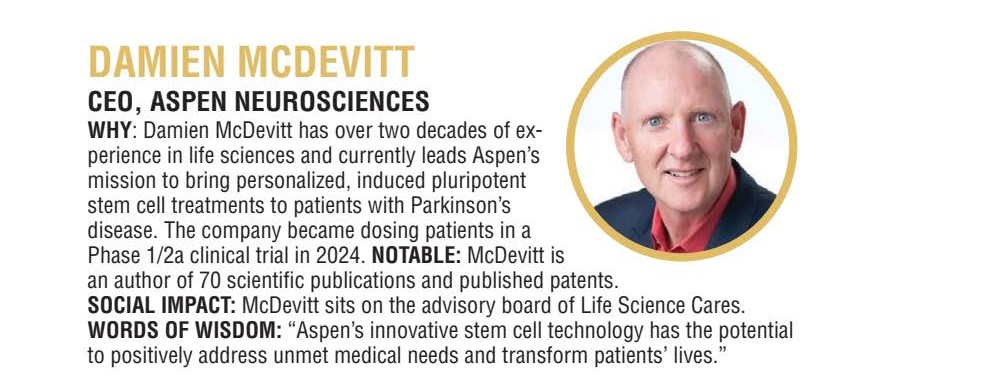
Our CEO, Damien McDevitt, was named in the San Diego Business Journal’s 500 Most Influential People in San Diego. With over two decades of experience in life sciences, Damien is leading our mission to bring personalized, induced pluripotent stem cell treatments to patients with Parkinson’s Disease. 

Read more here:

https://sdbusinessjournal.pressreader.com/san-diego-business-journal/20241118/

Aspen Neuroscience Chief Financial Officer Kameel Farag to Present at UBS Global Healthcare Conference

SAN DIEGO, Nov. 12, 2024 /PRNewswire/ — Aspen Neuroscience Chief Financial Officer Kameel Farag will present company updates in a fireside chat today at 4:15 pm PT at the UBS Global Healthcare Conference in Rancho Palos Verdes, Calif., where he will detail Aspen’s latest developments and future strategic plans for treating neurodegenerative diseases, including Parkinson’s disease. The UBS Global Conference is designed to bring together a premier group of C-Suite executives and institutional investors.

About Aspen Neuroscience 
Aspen Neuroscience, Inc., headquartered in San Diego, is dedicated to autologous regenerative medicine. The company’s patient-derived iPSC platform is used to create personalized therapies, a crucial step in addressing diseases with high unmet medical needs, starting with autologous neuron replacement for Parkinson’s disease. 

Aspen combines cell biology with the latest machine learning and genomic approaches to investigate patient-specific, restorative cell treatments. The company’s unwavering commitment to quality is evident in its best-in-class platform to create and optimize iPSC-derived cell therapies, which includes in-house bioinformatics, manufacturing, and quality control. For more information and important updates, please visit aspenneuroscience.com.

SOURCE Aspen Neuroscience, Inc.

Aspen Neuroscience Logo
Privacy Overview

This website uses cookies so that we can provide you with the best user experience possible. Cookie information is stored in your browser and performs functions such as recognising you when you return to our website and helping our team to understand which sections of the website you find most interesting and useful.